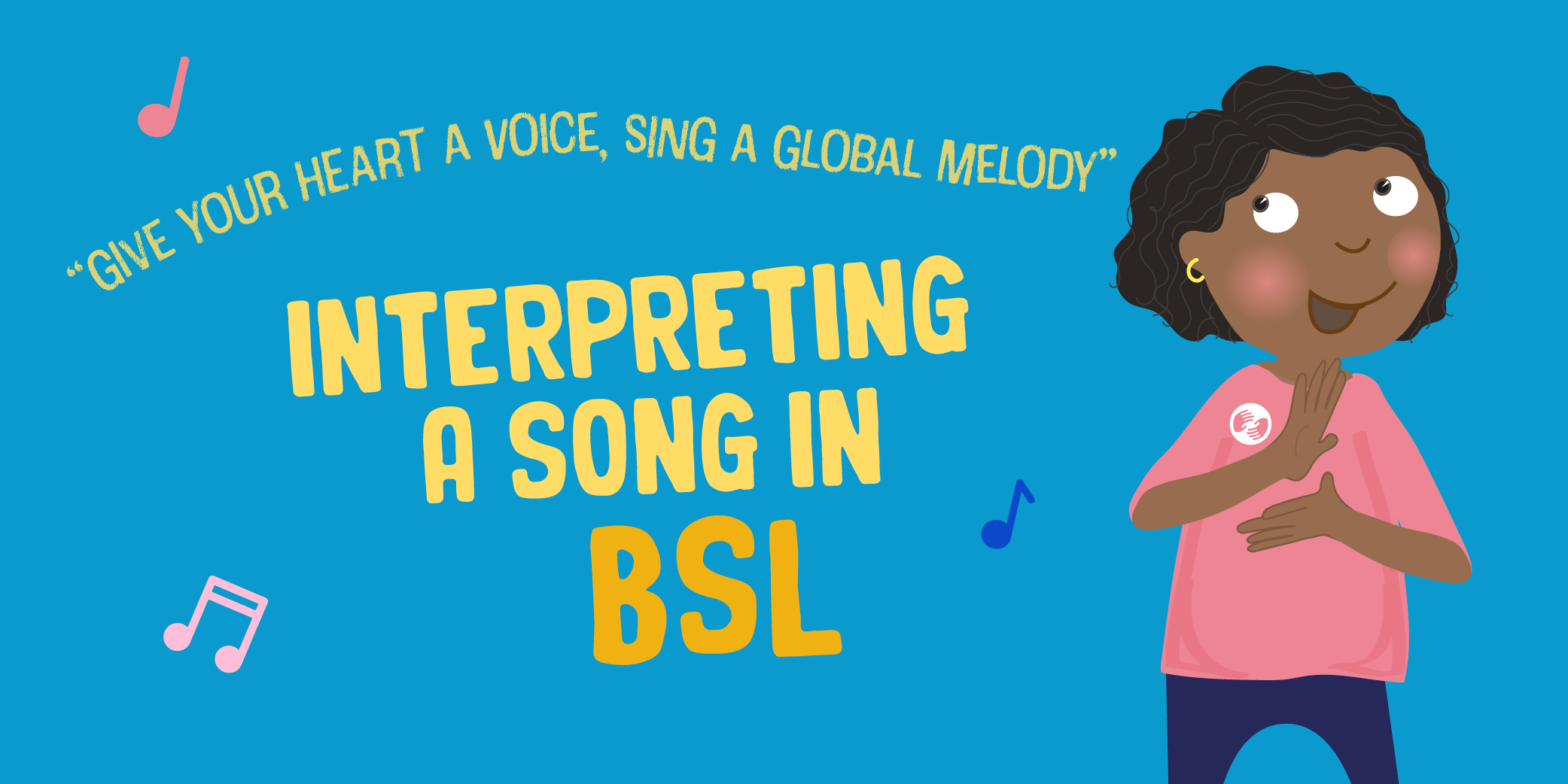
Following on from her previous blog, our new British Sign Language interpreter, Natalie Davies, tells us more about what makes a good song for signing and how she goes about interpreting the lyrics.
Choosing songs to translate into BSL is really difficult. There are so many factors to take into consideration, like…
- Do the lyrics translate correctly into BSL?
- Does the tempo and rhythm of the song match the signs that will be used?
- Do the signs flow well so they reflect the style of the song?
Let me explain a bit more. In my previous blog, I explained that BSL has its own grammatical structure. That means that translating songs into BSL isn’t as easy as signing all the words in English order, i.e. every word has a sign. You have to take each line of lyrics, in the context of the whole song, and work out the meaning of it.
My favourite example of this is the song ‘I dreamed a dream’ from Les Misérables. Look at the line ‘Then the tigers come at night, with their voices soft as thunder’. If we were to sign that using the English words there would be some very confused audience members wondering why tigers were suddenly prowling round the middle of France! And to say ‘voices soft as thunder’, well, last time I checked, thunder was really loud! We have to pick the story apart and work out what is really happening, in this instance it’s that the character is in danger, she doesn’t feel safe with the people she is with.
So, what makes a good song to translate? Songs with a clear story line are the best as visually you can create the story accurately. Even songs with multiple characters can be portrayed by one signer. You have to become each of the characters, showing their body language and emotions. The hardest songs to translate are those that contain metaphors or idioms as these don’t exist in sign language. It is a visual language so everything is taken very literally, for example ‘wear your heart on your sleeve’ would be very worrying to a BSL user. If a song had too many of these in, it would be really difficult to translate as the meaning is too vague to translate accurately.
Interpreting song lyrics, for me, happens in several stages. Let me break it down…
- STEP 1: I listen to the song whilst following along with the sheet music. I listen carefully to the lyrics and start to think about the meaning of the song.
- STEP 2: Next, I analyse the music thinking about what style the music is, what the tempo is, what emotions are shown through the song. This helps me to decide the best signs to use.
- STEP 3: I work through the song, line by line, and work out how to translate it into BSL. I think carefully about what the sentence means, the order the signs should go in, and which signs look best for the style of music.
That might not look like a lot, but interpreting songs is something that takes a lot of thought. It’s not just about translating the lyrics but looking at the song as a whole, thinking about the style, rhythm and tempo as well as the meaning of the lyrics. You are not only trying to portray the meaning of the song, but also demonstrate what the music sounds like. For example, in a fast song you would use more signs to give that up-tempo feel, in a sad song, you would choose signs that flow from one into the next with no sudden movements, whereas rocky songs you’d go high energy, moving your body a lot. You also have to depict the emotion of the song. Your body language and facial expressions play a huge part in the performance of a song. In speech we change the pitch and dynamic of our voice to help show how we are feeling, in sign language we rely on body language, facial expressions and the way we make a sign. Once I’ve done all that I am ready for Step 4…
- STEP 4: Put the music, signs, facial expressions and body language together to make a fully signed song.
The best thing you can do is to try and gain as much knowledge of the signs you are using. It will be much easier to teach to a group/class if you can explain what sign you are using. The other thing you might find useful is to make yourself an index of signs with little notes on how to do the sign. I used to do this all the time when I first started learning, I have pages and pages of notes of all the different signs I was learning with little comments of what shape my hands were in, what direction to move and which fingers were doing what. Over time you’ll find it easier and easier to remember new signs, but to start with, these little reminder notes can be really helpful. Finally, and most importantly, well done and thank you for taking the leap into using BSL with your class! I hope you all enjoy it as much as I do!
BSL signing videos are available for more than 45 songs in our catalogue, including many Out of the Ark favourites such as Everywhere Around Me, We Are One, Harvest Handclap and Child In A Manger Born. These are all available on Sparkyard or free with purchase of the relevant eSongbook.